Showing posts with label walking around. Show all posts

Friday, May 20, 2011

Photos I have Taken of People Taking Photos of Dumb Shit

When you live in a city with a lot of tourists, art students, models and photographers, it's not unusual to see someone taking a picture. You get used to it, you even get a little jaded about it. And sometimes you think, really? You're gonna take a picture of that?

And thus, a photo series was born. 


This last one turned out to be actual French pop star Yelle
who just played at First Ave in Minneapolis and at Coachella.
If you look at the photos on her Facebook site, 
you will see her wearing this exact leopard-print catsuit in concert.

Who knows, maybe the rest of this photo series will also turn out to contain famous people, amazing works of art (I mean, besides the Victory of Samothrace), or the work of celebrated photographers!

Sunday, May 15, 2011

Random Cool Things in Paris, part 2

Here's another couple of fun or interesting things we've seen over the past couple of months, which for one reason or another we didn't write a whole post about at the time.

1) Les Passages de Paris
We Minnesotans like to take the rather dubious credit for inventing the indoor shopping mall (oh how I do loathe Southdale). But we can blame the concept on the Parisians, who began building covered, semi-enclosed shopping passages in the early 19th century. Frankfurt school philosopher Walter Benjamin wrote a great deal about them, if you're into that kind of thing. One day back in February, Jeff and I set out to explore some of them.


Some of them are lovely, with what appear to be original lamps and decorations, and are filled with high-end clothing, antiques, gift shops, little cafés and restaurants, or design offices. Others are less well-preserved and a little ratty, but still retain some charm. If you get out of the center of town, you can find passages that are full of cheap wholesale clothing shops. Up by Porte St-Denis, some of them seem to host prostitutes, but we're not sure.

2. Église St-Eustache
We went into this church on a whim - we just happened to be walking by, and we wondered what it was like inside. Pretty cool, it turns out. This church was built in the late 16th-early 17th century, so it is a good example of the late Gothic style. Here's their website, in French, but if you've got Google translator you can figure it out.

And here's the apse end, peeking out through the Passage St-Eustache.

The nave and the organ.

Not sure who scandalized Peter Lorre so much,
but we didn't know he was a Catholic cardinal, either.

St-Eustache is right by les Halles in the 1st, for centuries the largest wholesale food market in Paris and the setting of Émile Zola's novel, Le Ventre de Paris [The Belly of Paris]. But the old market was demolished in 1971 and the food vendors banished to the suburbs. The diorama below dramatizes their departure.

There is now an underground shopping mall and a large, not terribly appealing park where the old Halles used to be. The city has ambitious plans to remake the space yet again.

We have just over two weeks left here in Paris, and parts of them will be pretty busy, but we'll try to update a couple more times before we leave.

Thursday, May 5, 2011

Musée Carnavalet Garden

Musée Carnavalet houses a collection related to the history of Paris. Entry to the museum, as well as the clean, functional bathrooms, is free, which is a great thing to keep in mind if you've downed too many Heinekens with your lunch at l'As du Falafel. While you can see much of the garden through the doorway on Rue des Francs Bourgeois, you need to enter through the courtyard on Rue de Sevigné to enjoy the view without the roving hordes. Get cleared through security, enter the lobby and then head out the wooden door at the end of the corridor to the left. Voilà - roses and topiary! 


Saturday, April 23, 2011

Parc de Bercy and Le Baron Rouge

Friday afternoon we set out for a walk to Parc de Bercy. On the way we took in the view from the bridge over Port de l'Arsenal, the marina directly south of Place de la Bastille. That's the Colonne de Juillet in the distance.


On the edge of Parc de Bercy, near the stadium and the highway is a pretty incredible skate/bike/rollerblade/razor scooter park.


This fountain tumbles down from the Simone-de-Beauvoir pedestrian bridge that connects the park to the left bank. I think the little guy in the lower right had just accepted a dare, putting his head under the flowing water to impress the girls upstream.


If you are keeping up, you know that we made plans after our first visit in November to return to Parc de Bercy when the roses bloomed in spring. Check out the rose garden map below. Formidable! We were still a little too early for most of the roses. Alas, we will have to return.


The early bushes were in bloom, but not the hybrids or the vines on the bower.


a small vineyard in the park


wisteria
November/April


It's duckling season. On the left, a mother in her nest. On the right, a group of male mallards pacing in the waiting room.


mother and little one


The ponds contain other wildlife: turtles and very handsome carp.


After the park we stopped by Le Baron Rouge to relax with a pot of rosé. Le Baron Rouge has a lot going for it: a beautifully worn room, welcoming staff, a family-friendly neighborhood vibe, a great wine selection and a cheap food menu with just the essentials (oysters and charcuterie). Due to its many virtues, it is mentioned in many Paris guides. It attracts a good number of tourists but manages to handle them gracefully and still maintain a local feel. One of the best parts of Le Baron Rouge is its house cask wine selection, available in reusable liter bottles. Two reds, a white and a rosé, filled and capped on demand for about €3.50 plus €.50 bottle deposit. In the afternoon you can often find a group of budget-conscious neighborhood ladies waiting, bottles in hand, for the doors to open. If you are having a party, or are just more honest about your wine consumption, you can get a 5 or 10 liter plastic jug with built-in spigot. Below, a young lady monitors the preparation of supplies for her mother and a group of friends.


Wednesday, April 20, 2011

Lyon, Continued

Our first nigh in Lyon we ate at Le Petit Bouchon Chez George, one of the oldest school bouchons in town. It's very small, as the name states, and has only one server and one cook. I generally dislike taking photos in restaurants, but I am not against stealing photos from other sites:

These two photos combined show the whole room. 
We sat exactly in the same spot, at the long communal table, with me in the photographer's position and Lia trapped in the middle of the banquette.

photos: http://www.itaste.com/list/restaurant/fr/lyon/au-petit-bouchon-chez-georges.html

 While every tourist trap in town calls itself a bouchon, only about 15 of them are certified authentique.


The food was truly correct, in the French use of the term, meaning not fancy or perfect, but proper and right. We sat next to a group of two Lyonnais couples who were obviously well versed in the local dining traditions. The man to my right would pick out his favorite gratons (crispy pork skin covered in fat, served as a finger food to start the meal) from the communal dish and hand them to me to eat, exclaiming their specific virtues. He liked the extra-crispy ones. We ordered an asparagus salad, gâteau de foie de volaille (a light, quiche-like tart made with chicken livers), lamb chops with red wine and figs, and tablier de sapeur (literally "fireman's apron", in reality a square flap of breaded and fried tripe). We finished with the classic Lyonnais cheese, St-Marcellin. 

The next morning we awoke not needing breakfast. 
We decided that a walk up Fourvière hill would be beneficial to our health. 

up                                                                    down

Into the trees.


The view from the top.


At the top is the Notre Dame de Fourvière Basilica. It was built in the late 1800s, around the same time as Sacre Coeur in Paris. They both share a love of amazing stained glass, tile mosaics and gold, gold, gold. I didn't take any interior photos. I think I was just excited to get on to the Roman ruins. 
A 5 minute walk from the basilica is this:


Fourvière was once a Roman settlement and there are many structures remaining, most notably the large theater (15AD) and the smaller odéon (2nd century) visible on the left. 

top of the main theater

A narrow, stone-paved road ran behind the theater walls.
 On the other side of the road was the town. 

 theater                                               road                           town

Lia on the Roman road


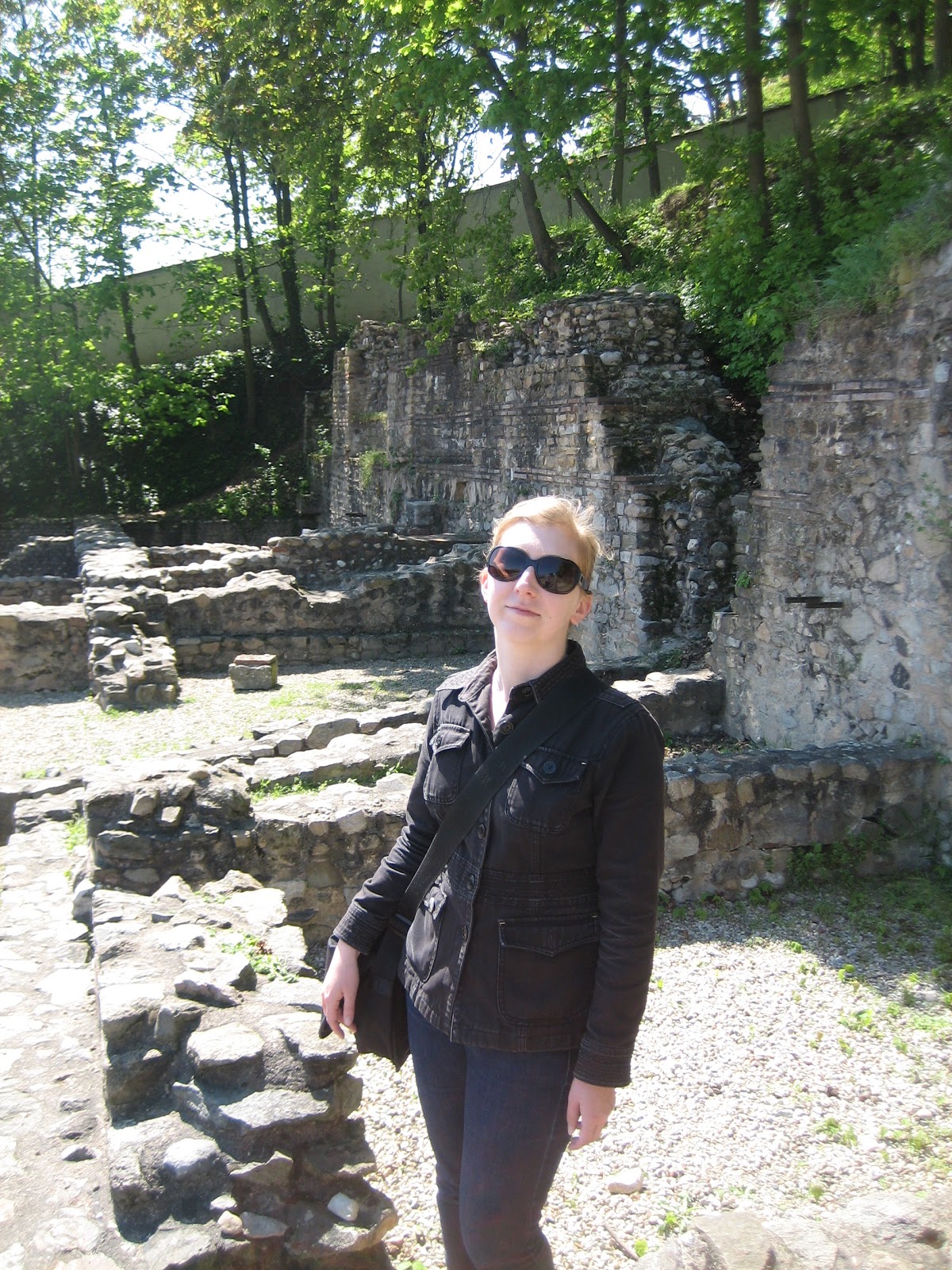
in the remains of the town


the odéon from above


The original marble tiled floor of the orchestra area is still mostly intact. 


Below is a little hint of what the walls would have looked like. 
The brick would have been covered with a thick layer of plaster and then painted.


marble mosaics were used as decorative trim


portions of the theater support columns are still standing


there are several groupings of homeless remains


for Mr Mitchell, examples of Roman baseboard molding


Later that day, back down the hill, we checked out the remains of the Amphitheater of the Three Gauls. It was a popular place to make Christian martyrs, as the sign explains. Ste-Blandine was "hung on a post and exposed as bait for the wild animals that were let loose on her." Read all about it here.


For dinner we visited Le Bouchon de Filles, a newer bouchon run by two women who had previously worked at Café des Fédérations, one of the larger, more popular bouchons in town. Le Bouchon des Filles serves the old school food with a more modern, refined touch. Here is a great review, with more photos, in English: http://kitchen-notebook.blogspot.com/2007/11/le-bouchon-des-filles.html