Showing posts with label church. Show all posts

Sunday, May 15, 2011

Random Cool Things in Paris, part 2

Here's another couple of fun or interesting things we've seen over the past couple of months, which for one reason or another we didn't write a whole post about at the time.

1) Les Passages de Paris
We Minnesotans like to take the rather dubious credit for inventing the indoor shopping mall (oh how I do loathe Southdale). But we can blame the concept on the Parisians, who began building covered, semi-enclosed shopping passages in the early 19th century. Frankfurt school philosopher Walter Benjamin wrote a great deal about them, if you're into that kind of thing. One day back in February, Jeff and I set out to explore some of them.


Some of them are lovely, with what appear to be original lamps and decorations, and are filled with high-end clothing, antiques, gift shops, little cafés and restaurants, or design offices. Others are less well-preserved and a little ratty, but still retain some charm. If you get out of the center of town, you can find passages that are full of cheap wholesale clothing shops. Up by Porte St-Denis, some of them seem to host prostitutes, but we're not sure.

2. Église St-Eustache
We went into this church on a whim - we just happened to be walking by, and we wondered what it was like inside. Pretty cool, it turns out. This church was built in the late 16th-early 17th century, so it is a good example of the late Gothic style. Here's their website, in French, but if you've got Google translator you can figure it out.

And here's the apse end, peeking out through the Passage St-Eustache.

The nave and the organ.

Not sure who scandalized Peter Lorre so much,
but we didn't know he was a Catholic cardinal, either.

St-Eustache is right by les Halles in the 1st, for centuries the largest wholesale food market in Paris and the setting of Émile Zola's novel, Le Ventre de Paris [The Belly of Paris]. But the old market was demolished in 1971 and the food vendors banished to the suburbs. The diorama below dramatizes their departure.

There is now an underground shopping mall and a large, not terribly appealing park where the old Halles used to be. The city has ambitious plans to remake the space yet again.

We have just over two weeks left here in Paris, and parts of them will be pretty busy, but we'll try to update a couple more times before we leave.

Tuesday, April 19, 2011

Lyon Day1

It's Spring Break. Woo! We had some trouble deciding how to get out of Paris this week. Amsterdam: too expensive, Berlin: too far, Cologne: maybe boring. Suddenly, it hit us- let's just go to Lyon and eat until we near death. It's close, relatively cheap and I guess you could say exciting. Lyon is traditionally thought of as the food capital of France. The Frenchiest of French gastronomy. Tons of toques, mountains of Michelin stars. It is especially known for its bouchons, old school food served in an old school environment. Red checked tablecloths, conviviality, friendly waiters, communal dishes of pork rinds, salads made entirely of meat. It's classic stuff, right out of your grand-mère's cookbook: fried tripe, stewed tripe, sausages made of tripe. Pig's feet, pig's head, veal head, lamb brains, lentils, quenelles. The mind reels. This article by Bill Buford sums it up nicely.    

We arrived in Lyon Wednesday afternoon.
 First stop, tourist office.

Place Bellefour. The third largest place in France where, for some reason, they love these sorts of useless, uncomfortable, dusty open spaces. It does provide a good, open view of the hill on the left bank. That's the Fourvière Basilica and Lyon's fake Eiffel Tower visible on top.


Lyon is located at the confluence of two rivers- the Rhone and the Saône. The central part of the city is on a peninsula called the presqu'île ("almost island"). Here is the view of St-Jean Baptiste de Lyon Cathedral, across the Saône.


In the square in front of the cathedral. It was windy.


Interior of the cathedral.


The cathedral is home to an astronomical clock, constructed in the 14th century.


We were there for the 3:00 show.


Later in the day we were at Place des Terreaux, in central Lyon.


Lia and L'Hôtel de Ville.


Monday, February 28, 2011

Chevreuse


Chevreuse is a small town set in the Yvette River valley, about 50 minutes by train to the southwest of Paris. It is most well known for Château de la Madelaine, a castle perched on a hill top overlooking the town. Madelaine is one of the few reasonably well preserved really old castles in the Île-de-France area. From what I can tell, it's a pretty common destination for lazy weekend exploration. The end of the RER-B line is in St-Rémy, so we got off the train and began the 45 minute walk to Chevreuse. 

There is a bike/foot path that follows the road from St-Rémy to Chevreuse. If you pretend really well, you can make out the Château about one-fourth of the way from the right side of this photo. Don't worry, we have better shots later.


The path was nice, but we spotted people walking by the river about 20 minutes in and decided to check it out. Chevreuse is also known for its "Promenade des Petits Ponts," a stretch of the river that is traversed by many small bridges. We entered the trail a little early, purposefully not noticing the "Voie Privée" signs, and were essentially walking through people's very pretty backyards. 


As we got closer to town, the petits ponts started to appear.
The doorway here is less than welcoming.


ducks!


Chevreuse was once a center for animal hide tanning. Most of the small buildings lining the river were dedicated to this purpose. There was a similar segment of the Bièvre River in southern Paris which was subsequently paved over due to the fetid waste produced by the tanning process. In Chevreuse the river smells fine, harbors animals and retains its old world charm. 

The Séchoir à Peaux is the largest of the "skin drying" buildings.


giant stone table visible through the doorway


Lia, perfectly hydrated, across from the séchoir.


so many petits ponts!


riverside lantern


I would rent that.


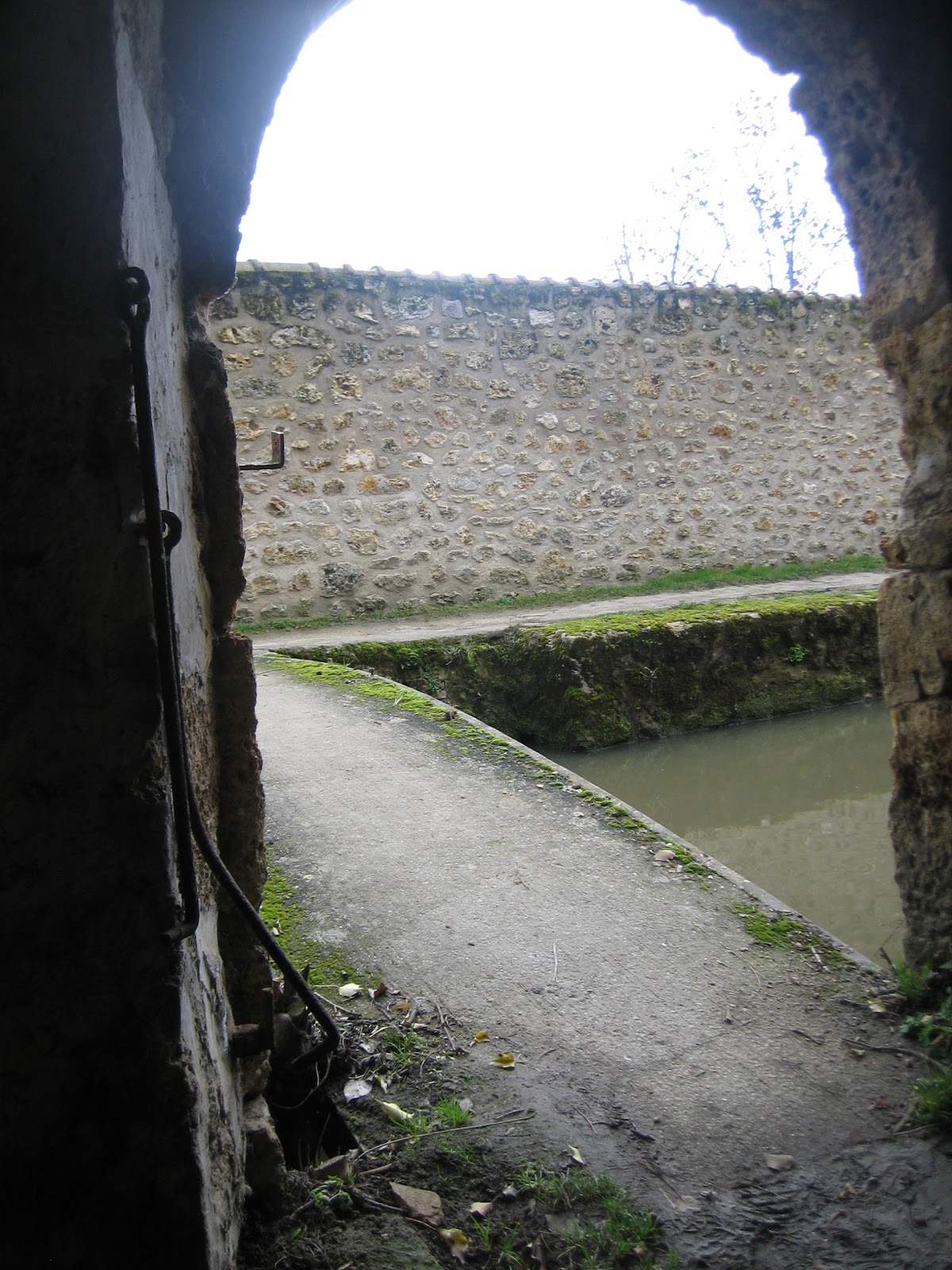
the view from one of the small tanneries


The two things I'll miss the most when we leave France?
doors and moss, obviously


In the center of town and, most importantly, upriver from the tanning houses, is the old public laundry house.


The path past the laundry leads into town and up to the château.


 The castle looms over the town.


the beginning of the way up


it's a long, steep path


voila!


Here is a panoramic shot of the interior of the château. The very tall structure on the left is the keep. Construction of the keep began in the mid-11th century. Originally surrounded by high wooden palisades, stone walls were built in the 12th century. Additional improvements were made until the 15th century at which point construction changed focus from fortification to upkeep and restoration. 


another view of the keep


Using our perfect archery form in defense of the castle.


The well, tended to like a cauldron by Sorcière Lia.


looking out over Chevreuse


Château de la Madelaine is the starting point for the Chemin de Jean Racine. The path is the same one taken by the playwright on his way from Chevreuse to the Port-Royal Abbey, where he studied under the Jansenists, a heretical religious movement which "emphasized original sin, human depravity, the necessity of divine grace and predestination." Sounds like fun. We didn't have time to make the 10km trek, but are planning a return visit.


"I am happy on these mountains
which rise up to the skies,
like a graceful tiara
crowning the beautiful countryside."

Or, something like that.


Back down the hill in the old part of town is St-Martin Church. 
Construction began in the 12th century. 


The wall paintings were especially beautiful despite their well worn state.


pious Lia


On the walk back to St-Rémy to catch the train Lia harassed a horse.